Budget 2026: What the New Federal Measures Could Mean for Your Money


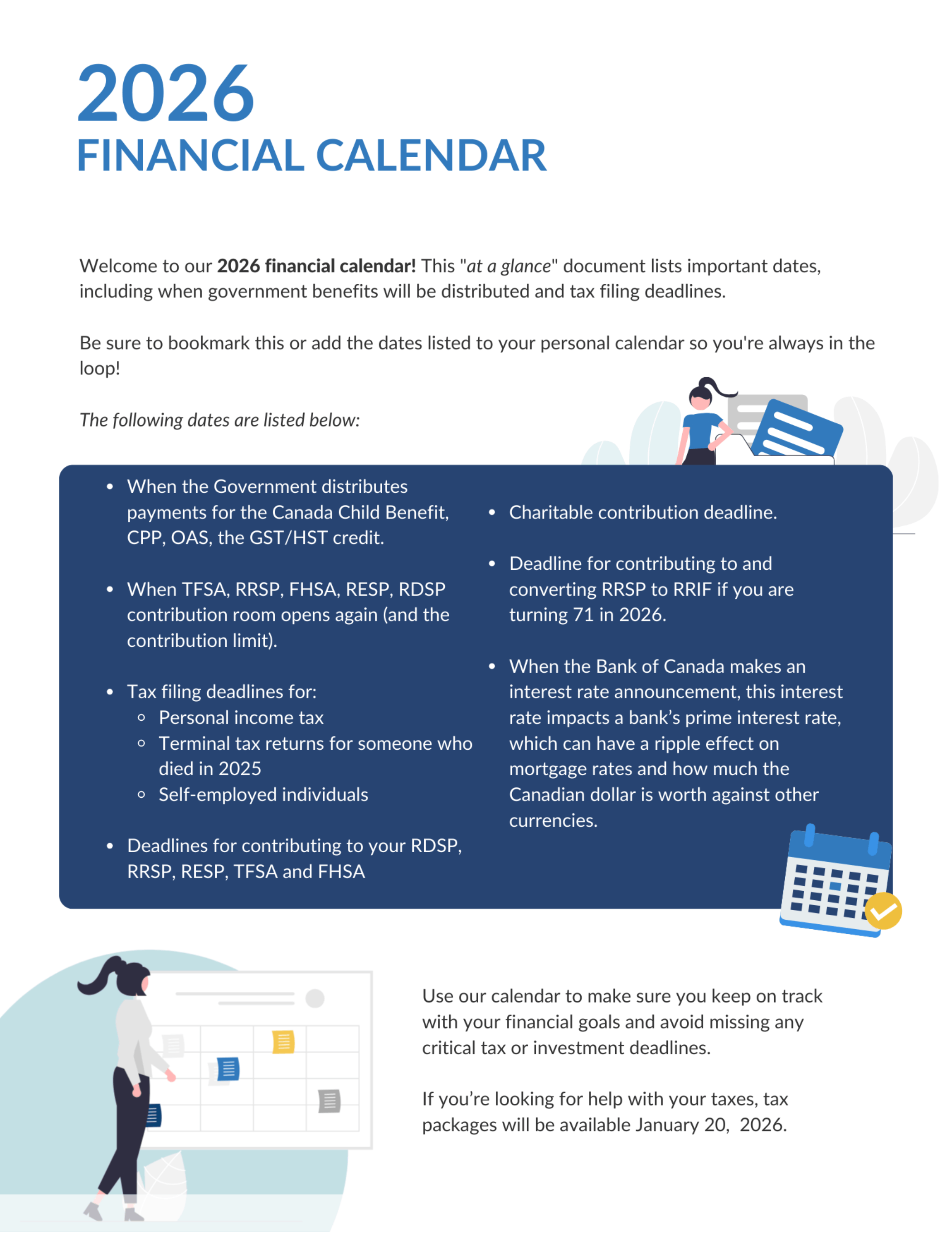
Welcome to our 2026 financial calendar!
This calendar is designed to help you keep track of important financial dates and deadlines, such as tax filing and government benefit distribution. You can bookmark this page for easy reference or add these dates to your personal calendar so you don’t miss any important financial obligations.
If you need help with your taxes, 2025 income tax packages will be available starting January 20, 2026. Don’t wait until the last minute to get started on your tax return – make an appointment with your accountant so you’re ready when tax season arrives.
On January 1, 2026, the contribution room for your Tax-Free Savings Account (TFSA) opens again. The TFSA dollar limit for 2026 is $7,000.
For those who are eligible, the contribution room for your:
Registered Retirement Savings Plan (RRSP)
First Home Savings Account (FHSA)
Registered Education Savings Plan (RESP)
Registered Disability Savings Plan (RDSP)
will also be available for the 2026 calendar year.
For your Registered Retirement Savings Plan (RRSP) contributions to be eligible for the 2025 income tax year, you must make them by:
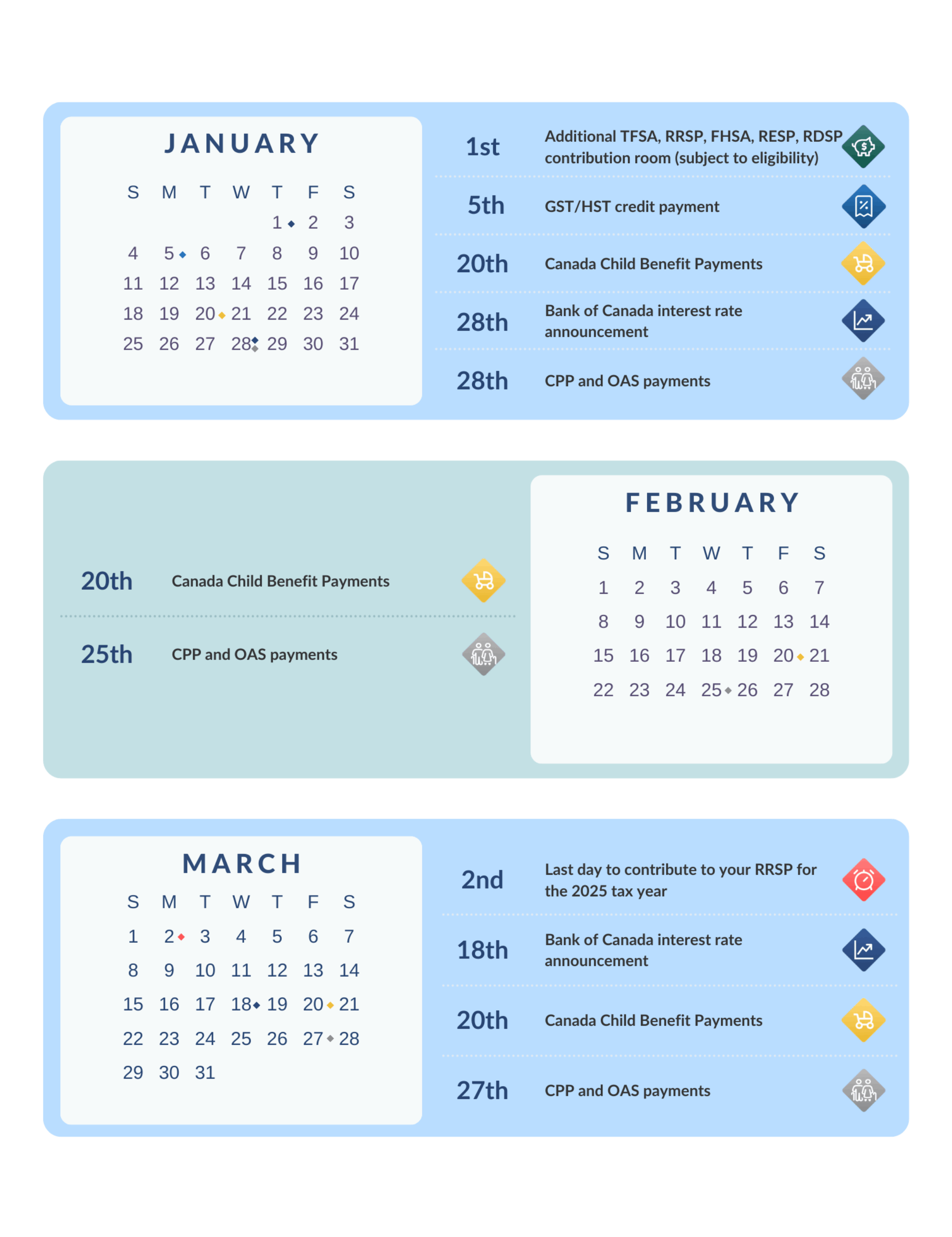
March 2, 2026
Contributions made after this date will generally count toward your 2026 tax return.
GST/HST credit payments will be issued on:
January 5
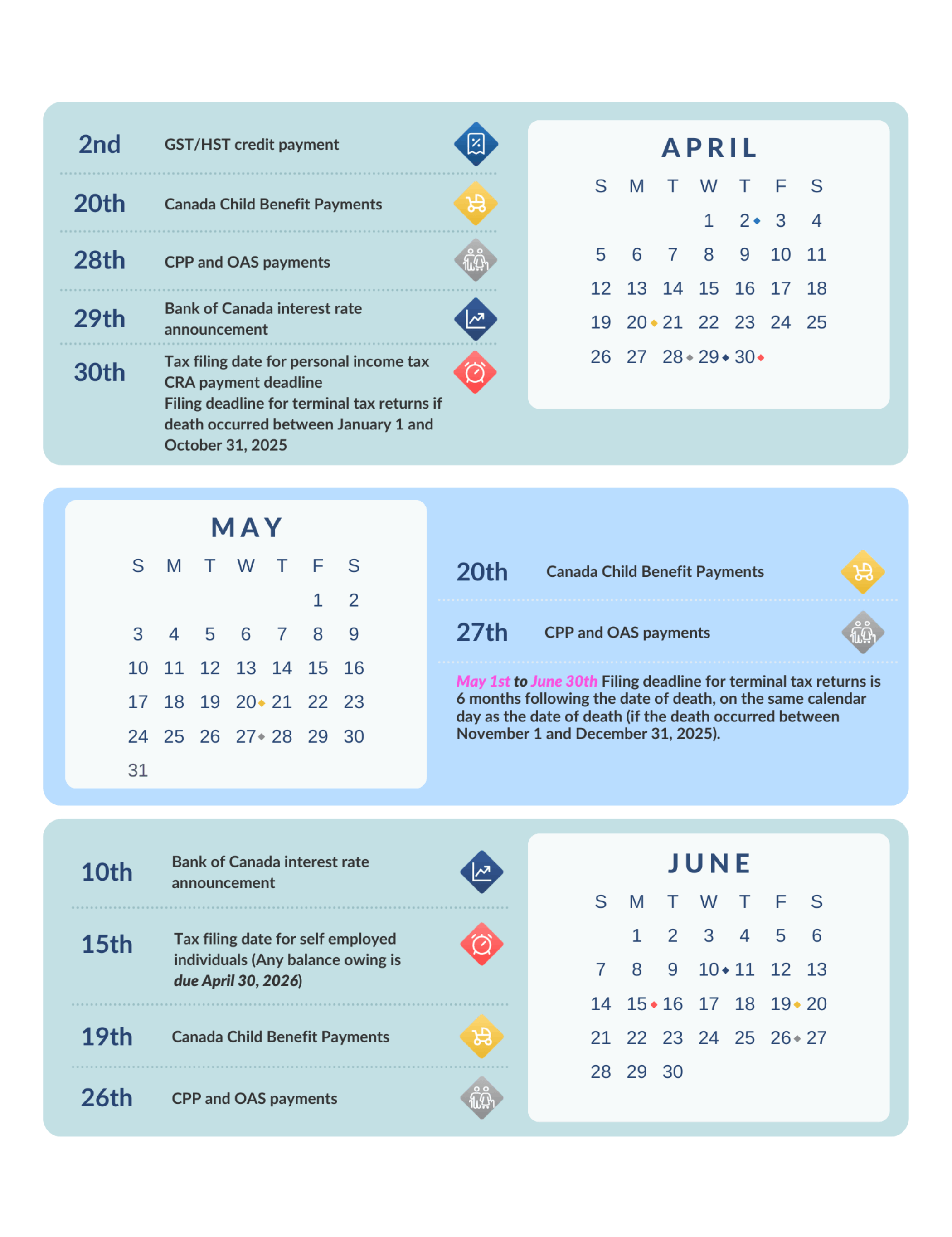
April 2
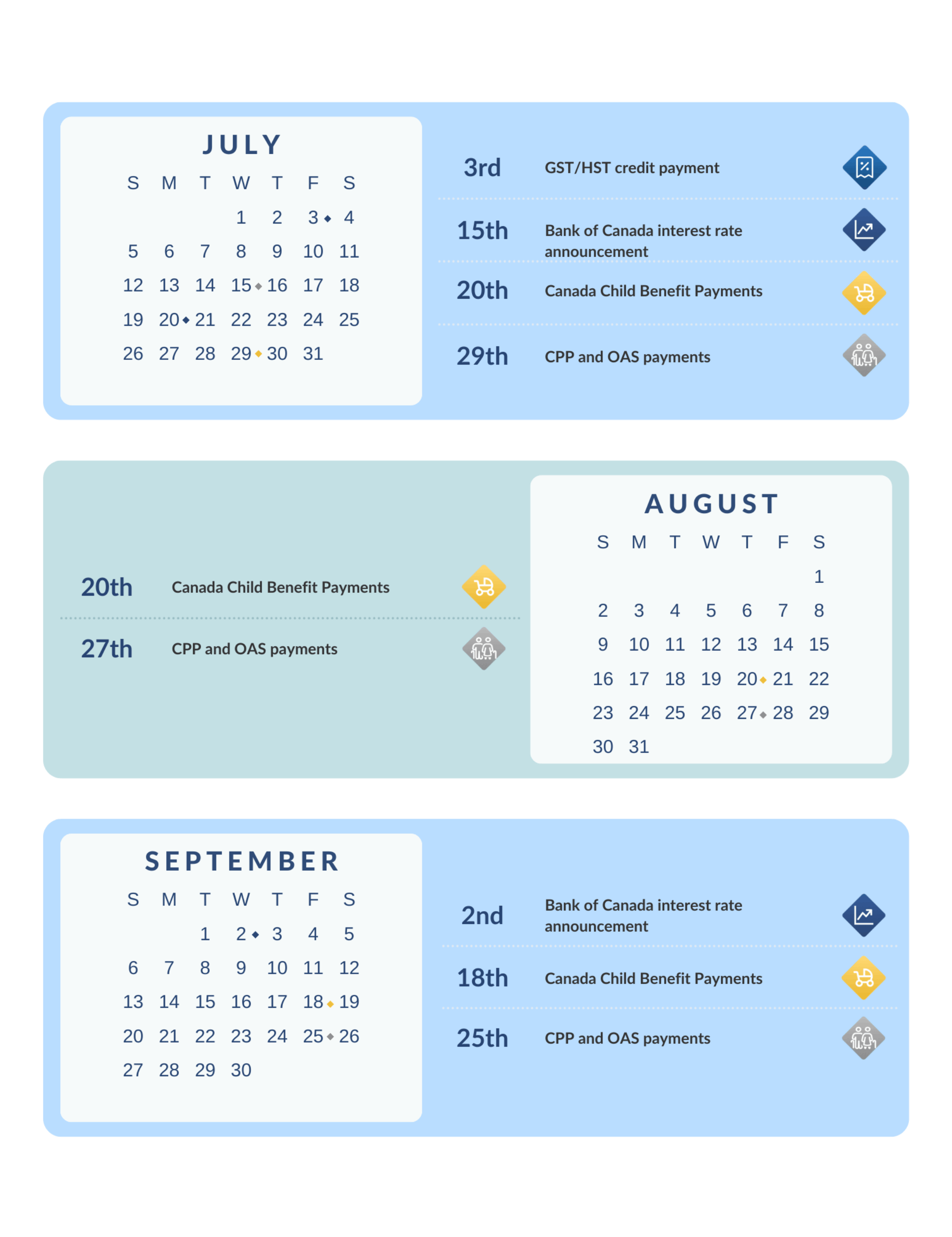
July 3
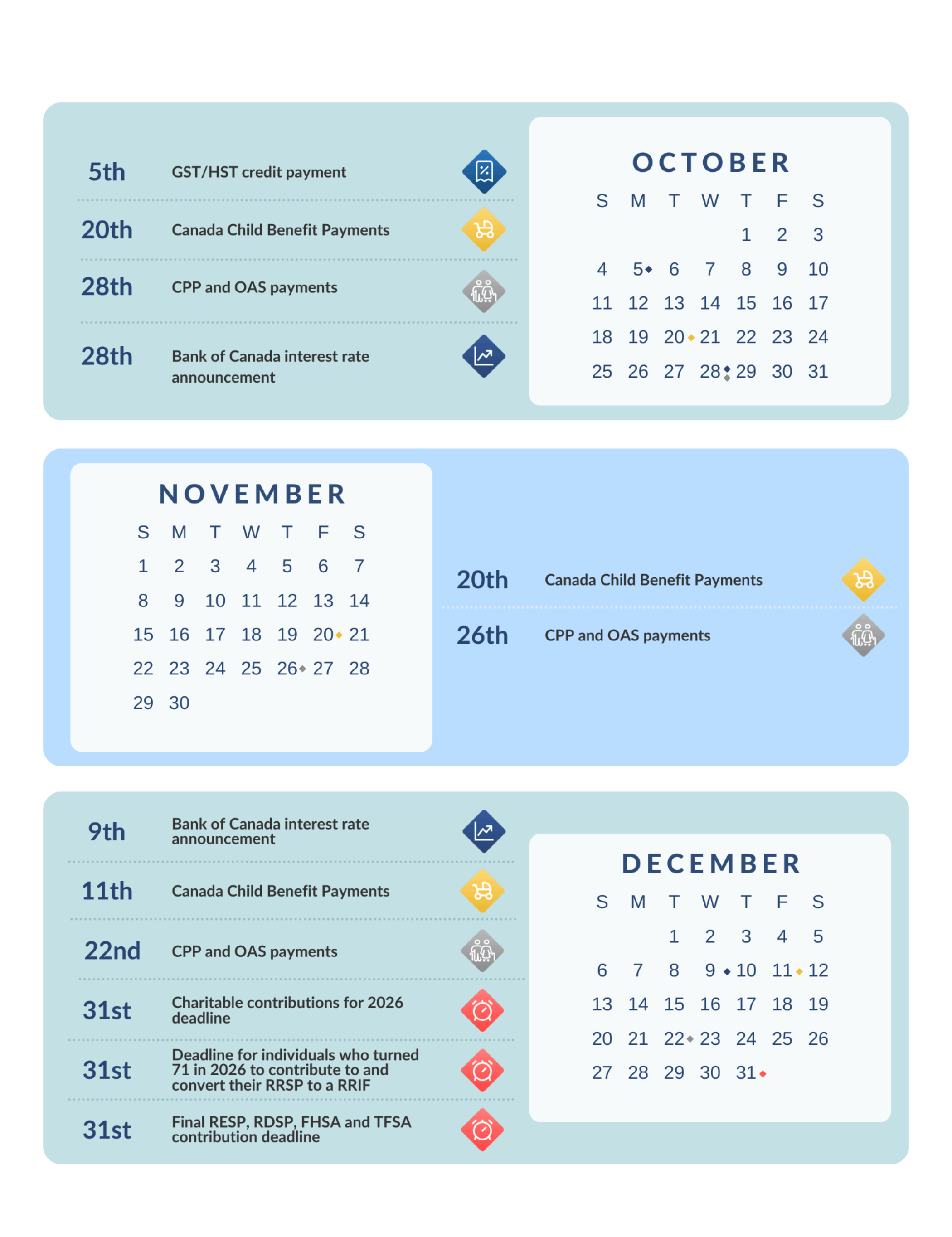
October 5
Canada Child Benefit payments will be issued on:
January 20
February 20
March 20
April 20
May 20
June 19
July 20
August 20
September 18
October 20
November 20
December 11
The government will issue Canada Pension Plan (CPP) and Old Age Security (OAS) payments on the following dates:
January 28
February 25
March 27
April 28
May 27
June 26
July 29
August 27
September 25
October 28
November 26
December 22
The Bank of Canada will make interest rate announcements on:
January 28
March 18
April 29
June 10
July 15
September 2
October 28
December 9
For most individuals, April 30, 2026 is the last day to:
File your 2025 personal income tax return, and
Pay any balance owing on your 2025 taxes.
This is also generally the filing deadline for final returns if death occurred between January 1 and October 31, 2025.
If death occurred between November 1 and December 31, 2025, the filing deadline for the final return is six months after the date of death (which will fall between May 1 and June 30, 2026).
If you or your spouse/common-law partner are self-employed:
The filing deadline for your 2025 tax return is June 15, 2026.
Any tax payments owing are still due by April 30, 2026.
Filing later than these dates may result in interest and penalties.
The final contribution deadline for the 2026 calendar year for the following accounts is December 31, 2026:
Tax-Free Savings Account (TFSA)
First Home Savings Account (FHSA)
Registered Education Savings Plan (RESP)
Registered Disability Savings Plan (RDSP)
December 31, 2026 is also the deadline for:
Making 2026 charitable donations that you want to claim on your 2026 tax return.
Individuals who turn 71 in 2026 to:
Make their last contributions to their own RRSPs, and
Convert their RRSPs to RRIFs (or an annuity).
Please reach out if you have any questions or would like help planning around any of these dates.
Sources:
Canada Revenue Agency. Tax-Free Savings Account (TFSA), Guide for Individuals. RC4466 (E), Canada.ca, https://www.canada.ca/en/revenue-agency/services/forms-publications/publications/rc4466/tax-free-savings-account-tfsa-guide-individuals.html.
Canada Revenue Agency. “Registered Retirement Savings Plan (RRSP).” Canada.ca, https://www.canada.ca/en/revenue-agency/services/tax/individuals/topics/rrsps-related-plans/registered-retirement-savings-plan-rrsp.html.
Canada Revenue Agency. “Registered Education Savings Plans (RESPs).” Canada.ca, https://www.canada.ca/en/revenue-agency/services/tax/individuals/topics/registered-education-savings-plans-resps.html.
Canada Revenue Agency. “First Home Savings Account (FHSA).” Canada.ca, https://www.canada.ca/en/revenue-agency/services/tax/individuals/topics/first-home-savings-account.html.
Canada Revenue Agency. “GST/HST Credit – Payment Dates.” Canada.ca, https://www.canada.ca/en/revenue-agency/services/child-family-benefits/gst-hst-credit/payment-dates.html#toc1.
Canada Revenue Agency. “Benefit Payment Dates.” Canada.ca, https://www.canada.ca/en/revenue-agency/services/child-family-benefits/benefit-payment-dates.html.
Canada. “Benefit Payment Dates Calendar.” Canada.ca, https://www.canada.ca/en/services/benefits/calendar.html.
Bank of Canada. “Bank of Canada Publishes 2026 Schedule for Policy Interest Rate Announcements and Other Major Publications.” Bank of Canada, https://www.bankofcanada.ca/2025/08/bank-canada-publishes-2026-schedule-policy-interest-rate-announcements-other-major-publications/.
Canada Revenue Agency. “Important Dates – Individuals.” Canada.ca, https://www.canada.ca/en/revenue-agency/services/tax/individuals/topics/important-dates-individuals.html.
Canada Revenue Agency. “Important Dates for RRSPs, RRIFs, and RDSPs.” Canada.ca, https://www.canada.ca/en/revenue-agency/services/tax/individuals/topics/rrsps-related-plans/important-dates-rrsp-rrif-rdsp.html.
On November 4, 2025, the budget was delivered by the Honourable François-Philippe Champagne, Minister of Finance and National Revenue.
The 2025 Federal Budget focuses on stability, simplicity, and long-term growth. There are no broad tax increases or major new spending programs. Instead, the government is emphasizing restraint, modernization, and productivity.
For individuals and business owners, the goal is clear: help Canadians access benefits more easily, encourage investment in innovation and clean energy, and update trust and estate rules to maintain fairness across the system.
Canada’s federal deficit is projected at $78.3 billion for 2025–26. The government aims to stabilize the debt-to-GDP ratio while maintaining funding for priorities such as housing, defence, and clean energy.
Spending will focus on programs that improve productivity, while efficiency reviews across departments are expected to reduce overlap and administrative costs. This marks a shift toward sustainable fiscal management and practical, targeted investments.
Several measures are designed to make life more affordable, particularly for first-time home buyers, caregivers, and lower-income households.
Eliminating the GST for First-Time Home Buyers
First-time home buyers will not pay the 5 percent federal GST on new homes priced up to $1 million. For new homes between $1 million and $1.5 million, a partial GST reduction applies. This change provides meaningful savings and makes new construction more accessible for Canadians entering the housing market.
Home Accessibility Tax Credit
Starting in 2026, expenses can no longer be claimed under both the Home Accessibility Tax Credit and the Medical Expense Tax Credit. The rule prevents duplicate claims but continues to support renovations that make homes safer and more accessible for seniors or individuals with disabilities.
Top-Up Tax Credit
To balance the reduction in the lowest federal tax bracket—from 15 percent to 14.5 percent in 2025, and 14 percent in 2026—the government introduced a Top-Up Tax Credit to preserve the value of non-refundable credits such as tuition, medical, and charitable amounts. This temporary measure, available from 2025 through 2030, ensures Canadians receive the same credit value even as rates decrease.
Personal Support Workers (PSW) Tax Credit
A new refundable tax credit equal to 5 percent of eligible income, up to $1,100 per year, will be available for certified personal support workers beginning in 2026. The measure acknowledges the importance of care professionals and provides direct relief to those in long-term and community-care roles.
Automatic Federal Benefits
Starting in 2025, the Canada Revenue Agency will begin automatically filing simple tax returns for eligible Canadians who do not normally file. This will allow low-income earners and seniors to receive benefits such as the Canada Workers Benefit, GST/HST Credit, and Canada Carbon Rebate automatically. Those with more complex financial situations will continue to file regular returns.
The budget introduces several changes affecting trusts and registered plans—key tools in long-term financial and estate planning.
Bare Trust Reporting Rules
Implementation of new bare trust reporting requirements has been delayed. The rules will now apply to taxation years ending December 31, 2026, or later. This postponement gives individuals, trustees, and professionals more time to prepare for the new filing obligations.
The 21-Year Rule for Trusts
Trusts—particularly most personal or family trusts—are generally considered to have sold and repurchased their capital property every 21 years (a “deemed disposition”). This rule prevents indefinite deferral of capital-gains tax on assets that grow in value.
When property is moved on a tax-deferred basis from one trust to another, the receiving trust normally inherits the original 21-year anniversary date so that tax timing does not reset.
Some estate-planning arrangements have transferred trust property indirectly—for example, through a corporation or a beneficiary connected to a second trust—so that the transfer did not appear to be trust-to-trust. These arrangements effectively extended the period before capital gains would be recognized.
Budget 2025 broadens the anti-avoidance rule to include indirect transfers. Any transfer of property made on or after November 4, 2025, that effectively moves assets from one trust to another will retain the original 21-year schedule.
For families that use trusts in estate or business-succession planning, this change reinforces the importance of reviewing structure and timing. Trusts remain valuable for asset protection, legacy planning, and income distribution—this update simply ensures consistent application of the 21-year rule.
Qualified Investments for Registered Plans
Beginning January 1, 2027, all registered plans—RRSPs, TFSAs, FHSAs, RDSPs, and RESPs—will follow a single harmonized list of qualified investments. Small-business shares will no longer qualify for new contributions, though existing holdings will remain grandfathered. The update simplifies compliance and clarifies which assets can be held in registered accounts.
For business owners, Budget 2025 provides opportunities to reinvest, innovate, and modernize operations, with emphasis on manufacturing, research, and clean technology.
Immediate Expensing for Manufacturing and Processing Buildings
Businesses can now claim a 100 percent deduction for eligible manufacturing and processing buildings acquired after Budget Day and available for use before 2030. This full write-off improves cash flow and encourages earlier expansion. The benefit will gradually phase out after 2033.
Scientific Research and Experimental Development (SR&ED)
The refundable SR&ED tax credit limit has increased from $3 million to $6 million per year, effective for taxation years beginning after December 16, 2024. This expansion strengthens support for small and medium-sized Canadian businesses investing in innovation and technology.
Tax Deferral Through Tiered Corporate Structures
To prevent deferrals of tax on investment income, new rules will suspend dividend refunds for affiliated corporations with mismatched fiscal year-ends. This ensures consistent taxation within corporate groups and aligns refund timing with income recognition.
Agricultural Co-operatives
The tax deferral for patronage dividends paid in shares has been extended to December 31, 2030, continuing to support agricultural co-operatives and their members.
Clean Technology and Clean Electricity Investment Credits
Clean-technology and clean-electricity incentives have been expanded to include additional critical minerals—such as antimony, gallium, germanium, indium, and scandium—used in advanced manufacturing and renewable energy production. The Canada Growth Fund can now invest in qualifying projects without reducing the amount of credit companies can claim, keeping the incentive structure attractive for green investment.
Canadian Entrepreneurs’ Incentive
The government has confirmed it will not proceed with the previously proposed Canadian Entrepreneurs’ Incentive. The existing Lifetime Capital Gains Exemption remains unchanged and continues to apply to the sale of qualified small-business shares.
To simplify administration and reduce complexity, two taxes are being repealed:
– Underused Housing Tax, beginning in 2025
– Luxury Tax on aircraft and vessels for purchases made after November 4, 2025
In addition, the Canada Carbon Rebate will issue its final household payment in April 2025, with no rebates available for returns filed after October 30, 2026. These changes are meant to streamline compliance and eliminate programs that were costly to administer.
Beyond taxation, the budget sets out the government’s broader policy priorities.
Downsizing Government: A comprehensive efficiency review is underway to eliminate duplication across departments and generate long-term savings.
Cuts to Immigration: To ease pressure on housing and infrastructure, temporary-resident levels will be reduced by about 20 percent over two years, while maintaining pathways for essential workers.
Defence Spending: Canada will invest an additional $7 billion over five years to strengthen NATO participation, Arctic defence, and cybersecurity. By 2030, defence spending is expected to reach 1.8 percent of GDP.
Oil and Gas Emission Cap: A phased-in cap starting in 2026 will allow companies to meet targets through carbon-capture and clean-tech investments rather than penalties.
For individuals, the most relevant updates include GST relief for first-time home buyers, improved benefit access, and continued tax relief for caregivers and support workers. For business owners, the focus remains on productivity—through immediate expensing, expanded SR&ED credits, and clean-tech investment incentives. For families using trusts or inter-generational structures, the clarified 21-year rule reinforces transparency in estate planning.
If you’d like to review what these changes mean for you or your business, please get in touch. We can look at your goals and make sure you’re well prepared for the year ahead.
This material is provided for general information only and should not be considered or relied upon as individual investment, tax, accounting, or legal advice. Before acting on any of the information presented, please obtain professional advice in the context of your particular circumstances.
On April 16, 2024, Canada’s Deputy Prime Minister and Finance Minister, Chrystia Freeland, presented the federal budget.
While there are no changes to federal personal or corporate tax rates, the budget introduces:
Capital Gains Inclusion Rate
The budget suggests raising the inclusion rate on capital gains after June 24, 2024:
For individuals, the $250,000 annual threshold that applies to net capital gains—the amount remaining after offsetting any capital losses. This includes gains acquired directly by an individual or indirectly through entities such as partnerships or trusts. Essentially, this threshold acts as a deductible, considering various factors to determine the net gains eligible for the increased capital gains tax rate.
Individuals in the highest income bracket, who earn above the top marginal tax rate threshold, will face a higher tax rate on capital gains exceeding $250,000 due to these changes. Furthermore, the budget modifies the tax deduction for employee stock options to align with the updated capital gains taxation rates yet maintains the initial 50% deduction for the first $250,000 in gains. Regarding previously incurred financial losses, the budget plans to adjust the value of these net capital losses from past years so that they are consistent with the current gains, upholding the uniformity with the new inclusion rate.
The budget outlines transitional rules for the upcoming tax year that straddles the implementation date of the new capital gains rates. If the tax year begins before June 25, 2024, but ends afterward, capital gains realized before June 25 will be taxed at the existing rate of 50%. However, gains accrued after June 24, 2024, will be subject to the increased rate of 66.67%. It’s important to note that the new $250,000 threshold for higher tax rates will only apply to gains made after June 24.
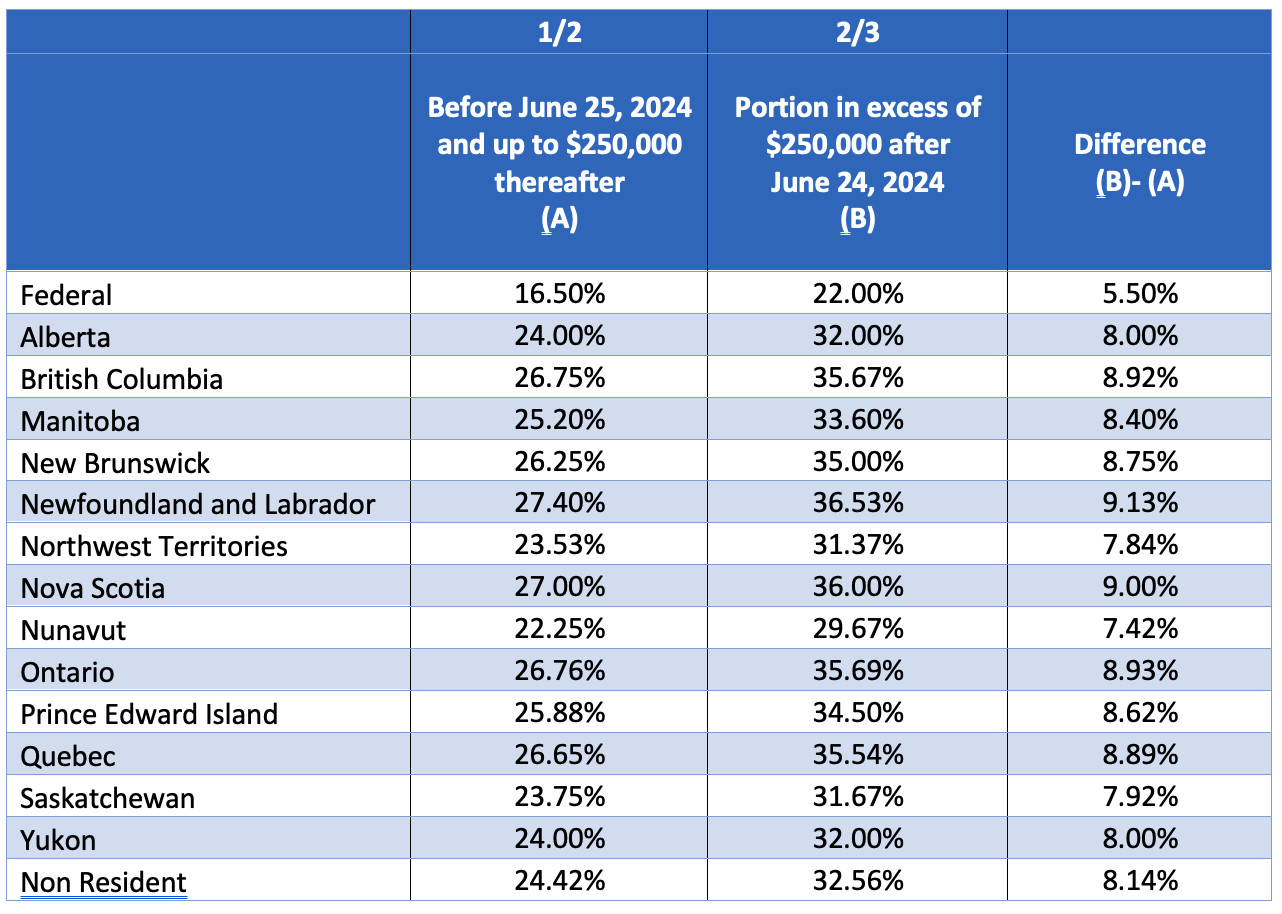
Consequently, for individuals earning capital gains beyond the $250,000 threshold and who fall into the highest income tax bracket, new rates will be effective as outlined in the table below. Specifically, this pertains to individuals with taxable incomes exceeding $355,845 in Alberta, $252,752 in British Columbia, $1,103,478 in Newfoundland and Labrador, $500,000 in the Yukon, and $246,752 in all other regions.
Further details and guidance on these new rules are expected to be provided in future announcements.
Lifetime Capital Gains Exemption
The budget proposes raising the Lifetime Capital Gains Exemption (LCGE) for qualified capital gains from $1,016,836 to $1.25 million, effective for sales made after June 24, 2024. Additionally, the exemption will once again be adjusted for inflation starting in 2026. This change aims to increase the tax benefits for individuals selling certain types of property, such as small business shares or farming and fishing assets.
Canadian Entrepreneurs’ Incentive
The Canadian Entrepreneurs’ Incentive is a new tax measure which provides a reduced inclusion rate on capital gains from the disposition of qualifying small business shares.
Qualifications for the incentive include:
This measure will apply to dispositions after December 31, 2024.
Alternative Minimum Tax (AMT)
The 2023 budget included updates to the AMT, with proposed changes outlined in the summer of 2023. The budget suggests revising the charitable donation tax credit for AMT calculations, increasing the claimable amount from 50% to 80%.
Further proposed changes to the AMT include:
These changes would take effect for tax years beginning after December 31, 2023. Additionally, the budget proposes technical amendments that would exempt specific trusts benefiting Indigenous groups from the AMT.
Employee Ownership Trust (EOT) Tax Exemption
The budget proposes a tax exemption on up to $10 million in capital gains for individuals selling their businesses to an EOT if certain criteria are met:
This exemption is valid for sales occurring from January 1, 2024, to December 31, 2026.
Home Buyers Plan (HBP)
The budget proposes enhancements to the HBP for 2024 and beyond, effective for withdrawals after April 16, 2024. These include:
Interest Deductions and Purpose-Built Rental Housing
The budget proposes a selective exemption from the Excessive Interest and Financing Expenses Limitation (EIFEL) rules for certain interest and financing expenses related to arm’s length financing. This exemption is for the construction or purchase of eligible purpose-built rental housing in Canada and applies to expenses incurred before January 1, 2036. To qualify, the housing must be a residential complex with either at least four private apartment units, each with its own kitchen, bathroom, and living areas, or 10 private rooms or suites. Additionally, at least 90% of the units must be designated for long-term rental. This exemption will be effective for tax years starting on or after October 1, 2023, in line with the broader EIFEL regulations.
Accelerated Capital Cost Allowance (CCA) – Purpose built rental housing
The budget introduces an accelerated CCA of 10% for new rental projects that start construction between April 16, 2024, and December 31, 2030, and are completed by December 31, 2035. This accelerated depreciation applies to projects that convert commercial properties into residential complexes or expand existing residential buildings that meet specific criteria under the EIFEL rules. However, it does not cover renovations to existing residential complexes.
Additionally, these investments will benefit from the Accelerated Investment Incentive, which allows for immediate depreciation deductions for properties put into use before 2028. Starting in 2028, the regular depreciation rules, including the half-year rule, will apply.
Accelerated Capital Cost Allowance (CCA)- Productivity-enhancing assets
The budget introduces immediate expensing for newly acquired properties that become operational between April 16, 2024, and December 31, 2026. This applies to specific categories such as:
Properties that are put into use between 2027 and 2028 will continue to benefit from the Accelerated Investment Incentive.
To qualify for this accelerated depreciation, the property must not have been previously owned by the taxpayer or someone closely connected to them, and it must not have been received as part of a tax-deferred deal. Also, if a tax year is shorter, the depreciation will be adjusted accordingly and will not carry over to the next year.
Canada Carbon Rebate for Small Businesses
The budget introduces a Canada Carbon Rebate for small businesses, offering a new refundable tax credit automatically. To be eligible, a Canadian-controlled private corporation must:
The amount of the tax credit for each eligible business will depend on:
We can help!
Wondering how this year’s budget will impact your finances or your business? We can help – give us a call today!